
CapitaLand Development (CLD) and Climate Group’s ConcreteZero initiative have launched ‘Concrete Data for Concrete Action’ – Singapore’s first market-wide reference for examining the carbon footprint of concrete. This benchmark establishes a credible baseline for the embodied carbon intensity of concrete supplied in Singapore, giving the construction value chain a single, shared starting point for the first time.
Developed through collection and analysis of verified environmental data from concrete suppliers, the benchmark represents a weighted average of embodied carbon performance across commonly used concrete mixes.
With the benchmark as a shared rulebook, the value chain is able to identify and choose lower-carbon concrete options. It aligns stakeholders across the built environment on reducing embodied carbon emissions together.
This transparency empowers demand and supply-side industry stakeholders to make informed decisions, while providing policymakers with the additional data to support standards across public and private projects. It also contributes to the evolution of certification schemes and helps track progress. In addition, it enables financiers to assess climate risk and support transition pathways.
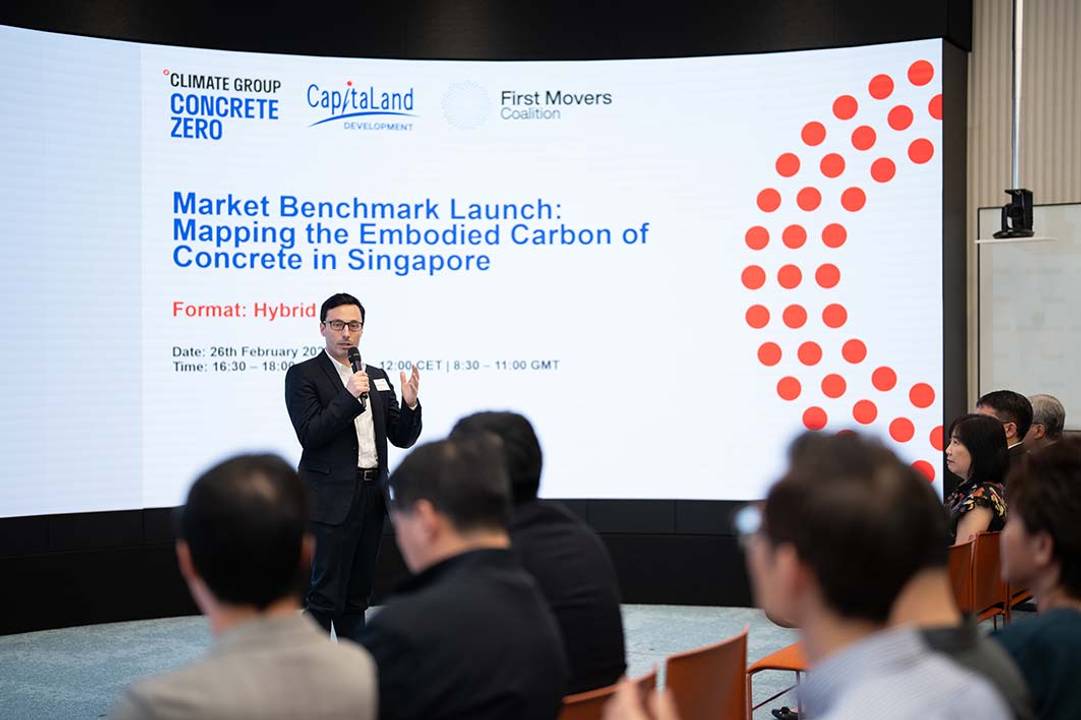
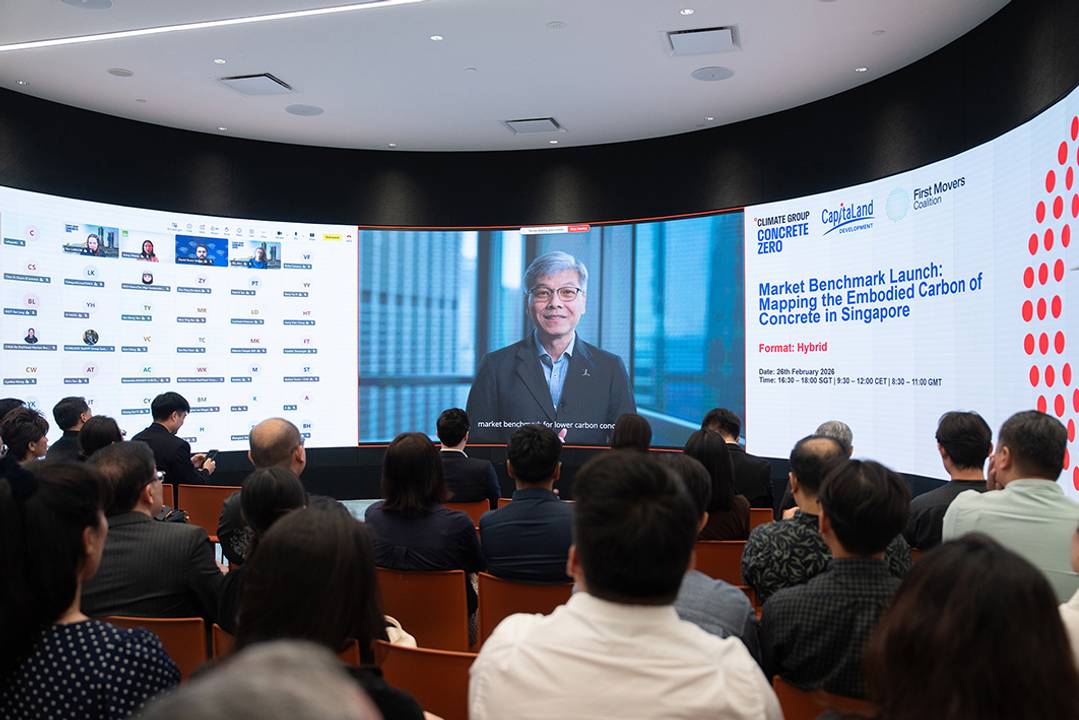
The benchmark was officially launched on Thursday (26 February) at a hybrid seminar that brought together industry leaders from Singapore, across Southeast Asia, and globally. The event was co-hosted by ConcreteZero, CLD and the World Economic Forum’s First Movers Coalition.
CLD is the development arm of Singapore-based CapitaLand Group, one of Asia’s largest diversified real estate groups. Speaking at the seminar, Giovanni Cossu, CLD’s head of sustainability, highlighted that covering almost 70% of the concrete market required strong collaboration with suppliers, other developers, regulators, banks and financiers.
“This market benchmark provides clearer definitions of what low-carbon concrete actually means. This is foundational, [as] investments can’t be made in products we can’t define,” said Daniel Boero Vargas, lead for industrial decarbonisation innovation, supply and concrete at World Economic Forum, who was also speaking at the seminar.
According to ConcreteZero and CLD, the report’s methodology provides a replicable template for future updates and for other markets seeking to develop similar benchmarks.
Accelerating concrete decarbonisation
The built environment accounts for almost 40% of global carbon dioxide emissions, with concrete alone accounting for 8%. By equipping developers, suppliers, regulators and financiers with a common reference point, the benchmark accelerates the transition from isolated pilot projects to systematic market adoption, reducing embodied carbon in construction at scale.
“Developing high-quality spaces that support construction decarbonisation begins with making responsible choices at every stage, including what we build with. This benchmark provides the market with a reference tool to recognise and value low-carbon concrete,” explained Tony Tan, chief corporate officer at CLD. “By aligning developers, suppliers, financiers and policymakers around shared data, it accelerates adoption at scale and helps buyers and investors identify buildings that will remain competitive as sustainability standards rise. This is what building for the long term looks like in practice to CapitaLand Development.”
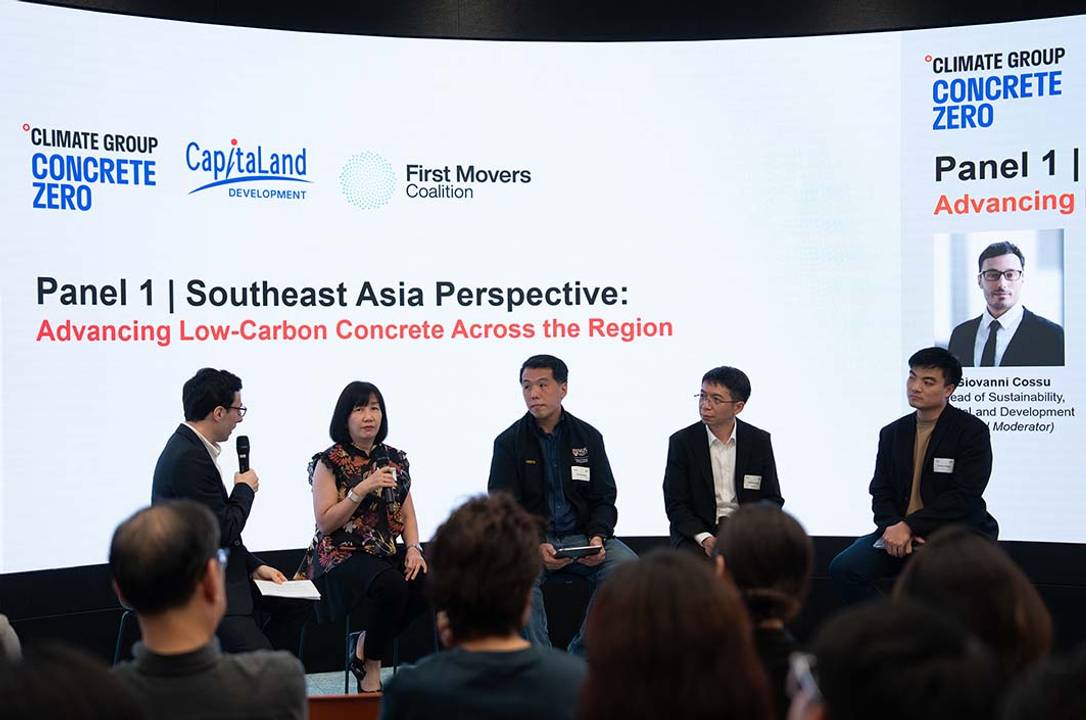
JTC Corporation, the government agency in charge of Singapore’s industrial development, also welcomes the launch of the benchmark – especially given the challenges in measuring embodied carbon. “You cannot manage what you don’t measure,” said Cheong Jiawen, director at JTC’s Future of Buildings & Infrastructure Division during a panel discussion. “Embodied carbon, unfortunately, unlike other forms of carbon such as operational carbon, is invisible to most people. So, this is fantastic, I really applaud the team in establishing a benchmark for concrete selection.”
According to Tan Chee Kiat, deputy CEO for industry development at Building and Construction Authority (BCA), “the findings from this industry-led study signal Singapore’s success in adopting low-carbon concrete. These insights will provide a roadmap for our stakeholders as they transition towards low-carbon developments. I am heartened to see our collective efforts in embodied carbon, supported by carbon management initiatives like the Singapore Building Carbon Calculator and the Green Mark Whole Life Carbon badge, delivering an impact on our built environment.”
For the Singapore Green Building Council (SGBC), the benchmark “validates the council’s long-standing efforts in market transformation for sustainable products,” said Yvonne Soh, CEO of SGBC. “By quantifying baseline emissions across the various concrete strength grades, we can now accelerate the transition to low-carbon concrete with greater strategic purpose and evidence-based action.”
Setting the pace across Asia
As Singapore imports most of its construction materials, the benchmark’s findings extend beyond the city-state, facilitating the wider Asian supply chain transition towards sustainable developments. The report draws on frameworks from the UK and Australia, adapted for Singapore’s market to ensure the data is internationally robust and regionally relevant.
Andrew Minson, concrete and sustainable construction director at Global Cement and Concrete Association (GCCA), said, “The GCCA concrete carbon ratings developed with UNIDO IDDO are designed to be used with local data, and so we enthusiastically welcome the work to establish the current embodied carbon of concrete in Singapore classified by strength. Local current data with global static ratings is the foundation for consistent low-carbon procurement to send meaningful design signals for suppliers.”
"Singapore’s embodied carbon benchmark is a critical step forward for Southeast Asia’s built environment,” stressed Mike Pierce, executive director, systems change at Climate Group. “As the country’s first standardised measurement framework for concrete, it gives industry the transparency needed to make informed decisions about low-carbon materials. This exemplifies how government-industry collaboration can accelerate the transition to net zero construction and provides a clear and replicable model for other countries to follow.”
Mr Vargas further pointed out that “Singapore’s role here is particularly significant. As an import-dependent hub with strong regional influence, the demand signal set in Singapore will have an effect across ASEAN supply chains. So when buyers in Singapore move, producers across the region will respond.”
“While operational carbon in buildings is increasingly regulated and addressed,” Mr Vargas noted that “embodied carbon is often seen as the next frontier, and that’s why the materials we choose today will shape emissions for decades to come.”
Other speakers and panelists at the seminar included: Jen Carson, head of industry, Climate Group; Nia Bell, senior manager, ConcreteZero, Climate Group; Prof. Pang Sze Dai, associate professor, National University of Singapore (NUS); Sang Lye See, executive director, DBS Bank; and Victor Fonseca, manager, climate solutions, Global Real Estate Sustainability Benchmark (GRESB).
Read the full report here.
Image credits:
Images 1-3: CapitaLand Development